

In the world of machining and toolholding, collets are essential for gripping cutting tools, drills, or workpieces with high precision and rigidity. Two of the most common types are ER collets and SK collets. While they may look similar at a glance, they are designed to different standards and excel in different applications.
Here’s a breakdown of their key differences.
1. Design and Standardization
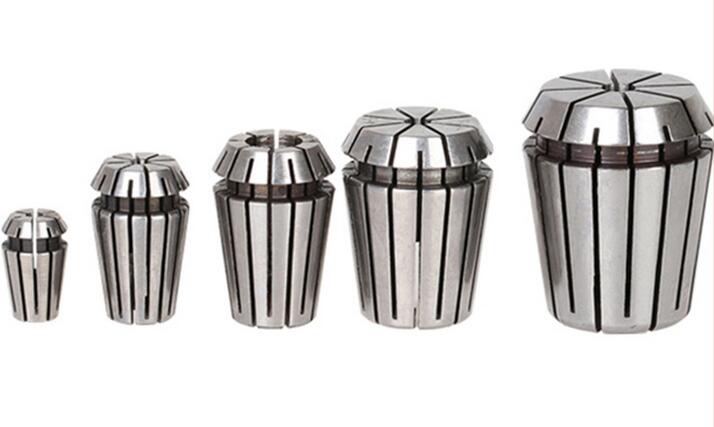
ER Collets (Elastic Ring Collets):
These are based on a international standard (DIN 6499). This means that an ER-25 collet from any manufacturer will fit any standard ER-25 collet nut and holder.
The key design feature is a large angle on the collet's taper (16°) and a corresponding angle inside the nut. This creates a strong clamping action as the nut is tightened, which forces the collet to compress evenly around the tool.
They have a series of precise slots that allow for significant elastic deformation, providing a large clamping range.
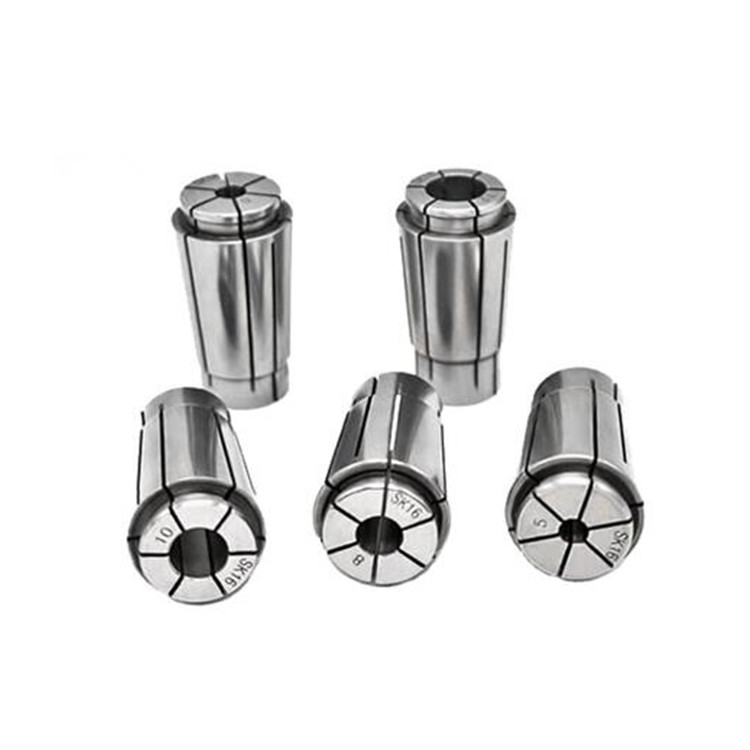
SK Collets (Spring Collets):
SK is a proprietary collet system originally developed and trademarked by Scully-Jones. It is not an open international standard like the ER system.
The collet has a much steeper taper angle (30°).
They have more and thinner slots than ER collets, which gives them a characteristic springy feel. This design is intended for high-speed, high-precision applications.
2. Clamping Range and Grip
ER Collets:
Excellent Clamping Range: This is their biggest advantage. A single ER collet can typically grip a range of 1mm. For example, an ER-20 collet can grip tools from 4mm to 13mm in diameter. This drastically reduces the number of collets needed for a full set.
Very Strong Grip: The 16° taper generates immense axial force, translating into exceptional gripping power. This makes ER collets ideal for heavy milling, drilling, and other applications with high cutting forces.
SK Collets:
Very Limited Clamping Range: An SK collet is designed to grip a single, specific size with extreme accuracy. The allowable size variation is minimal, often only a few hundredths of a millimeter.
Good, but Softer Grip: The grip is precise but not as powerful as an ER collet's. The 30° taper does not generate the same level of axial force. The grip is more like a gentle, consistent squeeze, which is perfect for preserving the integrity of delicate tools.
3. Precision and Runout
ER Collets:
Offer very good precision and low runout (typically within 0.0005" or 0.012mm when used with a quality set), which is sufficient for most CNC machining tasks.
SK Collets:
Are renowned for extremely high precision and minimal runout. Their design allows for near-perfect concentricity. This makes them the preferred choice for ultra-high-speed spindles and applications where the slightest inaccuracy is unacceptable, such as in precision grinding or PCB drilling.
4. Primary Applications
ER Collets:
General CNC Milling and Drilling: The workhorse of most machine shops.
Lathe Toolholding: Commonly used in CNC lathes for live tooling (milling and drilling on a lathe).
3D Printer Extruders:A very common adaptation for gripping filament.
Any situation where versatility, grip strength, and cost-effectiveness are priorities.
SK Collets:
High-Speed Spindles (HSM):Commonly found in machining centers designed for very high RPMs.
Precision Grinding: Where tool runout must be virtually zero.
PCB Drilling and Routing: The tiny, fragile drills used for circuit boards require the gentle, precise grip of an SK collet.
Specialized and Legacy Equipment: Many older or specialized machines were built specifically for the SK standard.
Conclusion: Which One Should You Choose?
The choice is straightforward:
Choose ER Collets for 95% of general machining applications. They offer the best balance of gripping power, versatility, and value. If you need to hold a variety of tool sizes with a minimal set of collets, ER is the answer.
Choose SK Collets when your primary requirement is extreme precision and minimal runout at very high speeds. They are a specialized tool for applications where the highest level of accuracy is critical, and where tools are matched exactly to the collet size.
In short, ER is the versatile heavyweight, while SK is the precision specialist.