

How to Ensure and Improve ER Collet Accuracy in Production?
Ensuring and improving the accuracy of ER collets is a systematic engineering effort that extends beyond basic usage to encompass selection, handling, and process optimization.
Part 1: How to Ensure ER Spring Collet Accuracy (Fundamental Practices)
This is the foundation for maintaining precision and avoiding common errors.
1. Source Control: Procurement and Inspection
Choose Reputable Brands: Opt for well-known brands (e.g., REGO-FIX, SCHUNK, BIG DAISHOWA, HAIMER) known for strict quality control and advanced heat treatment processes.
Verify Accuracy Grade: ER collets are typically classified as Class C (Standard) or Class B (Precision). For high-speed, high-accuracy machining, always use **Class B** (accuracy ~±0.005mm) or higher. Check the product specifications.
Incoming Inspection: Sample new collets using a presetter and a high-precision test bar to measure radial runout, ensuring they meet the stated specifications.
2. Correct Usage and Installation: Avoiding Human Error
Cleanliness is Critical:
Absolute (Taboo): Never install a tool into a dirty collet. A single tiny metal chip or speck of dust can cause significant runout and scratch the collet bore.
Standard Procedure: Before assembly, thoroughly clean the collet's internal taper, external taper, the lock nut's threads and thrust face, and the tool's shank with isopropyl alcohol and a lint-free cloth.
Proper Installation Sequence:
Wrong: Fully assemble the collet into the nut first, then slide them onto the tool holder.
Right:
1. Insert the cleaned collet into the holder's taper by hand. It should hold in place by friction.
2. Insert the tool into the collet to the desired length.
3. Hand-tighten the lock nut onto the holder, ensuring the collet doesn't shift.
4. Use a torque wrench to tighten the nut to the manufacturer's recommended torque value.
Use a Torque Wrench:
Never use cheater bars or impact wrenches! Overtightening permanently deforms or cracks the collet; undertightening causes tool slippage, damaging the tool and workpiece.
Atorque wrench is mandatory for applying the correct, specified force.
3. Daily Maintenance and Care
Regular Inspection & Replacement:
Visual Check: Regularly inspect collets for wear, scratches, cracks, or rust.
Accuracy Check: Use a presetter with a master test bar to measure radial runout. If runout exceeds tolerance (e.g., >0.01mm for Class B), replace the collet immediately.
Lifecycle Management: Track collet usage. Consider them consumables. Establish a conservative replacement schedule based on cycle count (e.g., replace after 1000 cycles) and downgrade old collets for roughing operations.
Proper Storage: Store collets in a clean, dry, dedicated organizer to prevent corrosion and damage from knocking together.
4. Systemic Accuracy Management
Tool Holder Maintenance:The holder's taper (BT, HSK) must also be clean and undamaged. A worn holder will ruin system accuracy regardless of collet quality.
Use a Presetter: An offline presetter is essential for high-precision work. It allows you to measure and minimize tool runout before the tool enters the machine spindle, compensating for minor errors in the collet and holder.
Operator Training:Ensure all personnel understand the importance of precision and are rigorously trained in the correct cleaning and installation procedures.
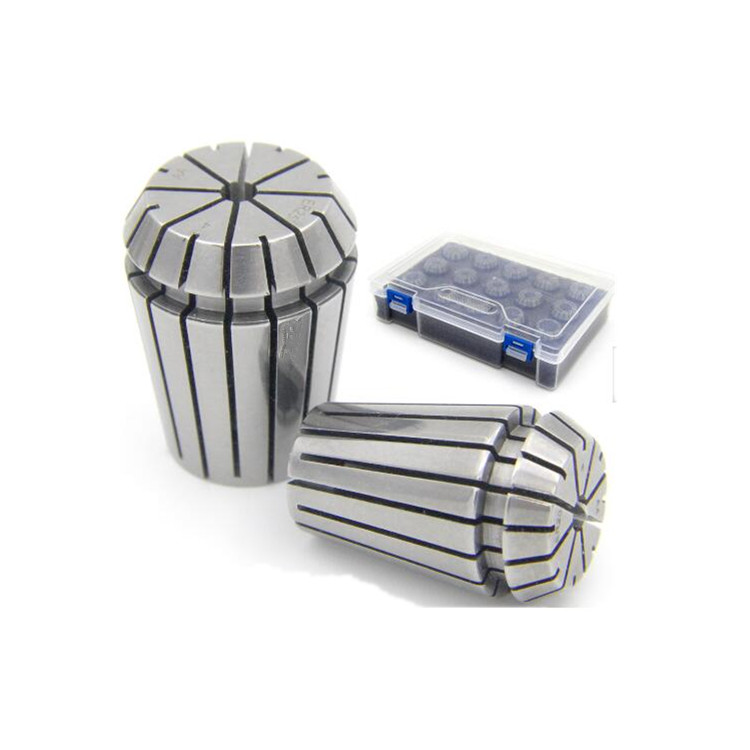
Part 2: How to Improve ER Collet Accuracy (Advanced Practices)
These steps push the system towards its theoretical accuracy limits.
1. Superior Selection: Beyond the Basics Ultra-Precision Collets:Seek out Class A (Ultra-Precision, ~±0.003mm) or AA grade collets for demanding applications like finish machining or hard milling.
Balanced Components: For high-speed machining, use collets and nuts that are dynamically balanced to G2.5 or better. This reduces vibration, improves surface finish, and protects spindle bearings.
Upgrade the Lock Nut: Standard nuts are a common source of error. Invest in high-precision nuts (e.g., internal-style, sealed nuts). Internal-style nuts help center the collet better, improving concentricity.